At a glance
- Difficulty
- Advanced
- Climbing
- Trad, Multi-pitch
- Rock
- Granite
- Best seasons
- Summer
- Wall height
- Up to 1,000 m+
- Approach
- 12 km hike to base camp + 600–800 m vert (2-4 hrs) to upper valleys
- Region
- Los Lagos Region, Chile
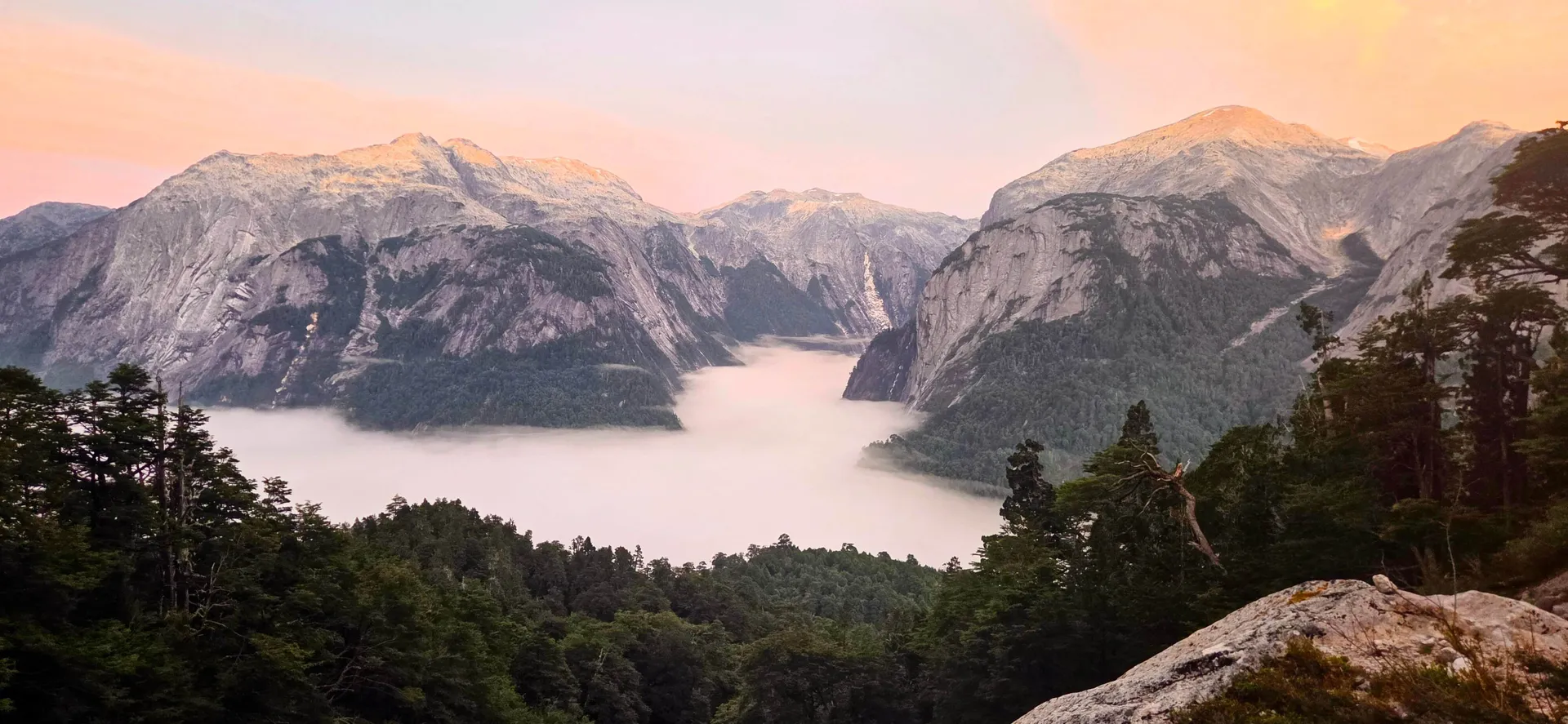
Cochamó is a lush, wild valley in Chile’s Los Lagos Region that’s earned the “Yosemite of South America” label — and for good reason. Coarse silver-grey granite domes rise out of dense temperate rainforest, with sweeping walls topping 1,000 metres. The catch: everything is remote, the approach is a proper 12 km hike, and the weather is famously unpredictable. That’s also what makes it feel so special.
Overview
Tucked between Puerto Montt and the Argentine border, the Cochamó valley is one of the most striking granite climbing destinations in South America. Unlike its Yosemite comparison, there’s no road to the base of the walls — you hike in (or ride horses), camp at simple sites along the river, and climb on trad-protected granite that ranges from endless friction slabs to splitter cracks and steep arêtes.
It’s overwhelmingly trad climbing, with a big-wall multi-pitch focus. There’s a small amount of sport and cragging on steeper faces, but the headline experience is committing multi-pitch lines on huge domes, often with an alpine feel and complex descents.
What Makes It Special
World-Class Granite: The rock is coarse, silver-grey granite — compact slabs, sweeping domes, and glacier-polished faces. Quality ranges from perfect on the major walls to more grainy or vegetated sections on newer lines still being cleaned and developed.
Real Adventure Climbing: This isn’t a roadside crag. The approach, the weather, the lack of phone signal, and the commitment of the routes all contribute to a genuine backcountry climbing experience. You earn your pitches here.
Trad Paradise: Cochamó is a trad climber’s dream. Think splitter cracks, friction slab, corners, mixed face-and-crack pitches — often with runout sections that demand solid footwork and headspace. If you like placing gear and reading rock, this is your place.
The Setting: Dense rainforest, glacial rivers, towering granite walls emerging from the canopy. It’s beautiful in a way that photos don’t quite capture.
The Scene
The climbing community in Cochamó is small, friendly, and international. You’ll share beta at camp, coordinate on routes, and spend rainy days playing cards in the hut.
Camping La Junta is the main climber campsite and has the best vibes — warm solar showers, toilets, a communal hut with a fire for rainy days, and hosts who speak English and share beta. It books out roughly three months in advance, so plan early.
Vista Hermosa is the next best option — more flexible bookings and a good base. They sell eggs and bread at decent prices, and you don’t pay for camping if you’re up at the bivvy with your tent packed down, which saves money since you’ll spend most of your time in the upper valleys.
Trawen is the most expensive and busiest camp, popular with locals and younger crowds — it can be noisy. They have a small restaurant selling pizza (~A$40 / ~US$28) and basics like eggs, bread, and sometimes veg. They also run Starlink: 5,000 CLP (~US$6) for 15 minutes (though you’ll often get closer to an hour). Phone charging is available when the solar panels are producing, though power runs out quickly in bad weather.
Camp preference: La Junta > Vista Hermosa > Trawen. Avoid Manzanos — it’s too far from the climbing.
Rest Days
- Rainy day at camp: Bring a Kindle, a pack of cards, or a sketchbook — you will get rained out. The hut at La Junta with its fire makes this much more bearable.
- Vista Hermosa eggs and bread: Cheap, filling rest-day fuel.
- Trawen pizza and Starlink: If you need to check in with the outside world or treat yourself to a hot meal.
- The hike out and back: Some parties use rest days to resupply from the trailhead or the towns.
Getting Started
Cochamó rewards self-sufficiency. You should be comfortable placing trad gear, managing multi-pitch systems, navigating without phone signal, and dealing with variable weather before committing to the bigger walls.
Camp Farm is a great first objective — shorter, friendlier in length, on high-quality granite, and a solid introduction to the scale and rock of the valley without committing to a huge wall.
From there, step up to routes like Shark Fin (more of a sport feel, with an epic granite arête) before tackling the longer, more committing lines.
Be aware that the weather can turn fast — always have a plan for retreat, bring layers, and don’t underestimate the approaches to the upper valleys.
Logistics & Planning
How to get there, where to stay, shopping beta, and practical information for planning your Cochamó trip.
Getting There
By Air
Fly into Puerto Montt (PMC) from Santiago. From the airport, you’ll need a taxi or transfer into town — expect about A$30 (~US$21).
Alternatively, you can take a bus from Santiago to Puerto Montt — it’s much cheaper and gets you straight into town, but it’s a long ride.
Puerto Montt vs Puerto Varas
You’ll need to spend at least one night near Puerto Montt to shop and sort logistics before heading to the valley. Two options:
- Puerto Montt: Better groceries, cheaper accommodation, less charm. Better if you’re optimising for cost and shopping access.
- Puerto Varas: More expensive, much nicer vibes, but less supermarket variety. Worth it if you want a nicer base for a night or two.
The Bus to Cochamó
From Puerto Montt, catch the bus from the Puerto Montt bus terminal:
- The company you want is “Rio Puelo” — they depart from the north-east end of the terminal.
- No need to book in advance — just pay on the bus.
- Important: If there are two buses, get on the small bus, not the coach. The coach continues past Cochamó town, but the small bus takes you directly to the Cochamo trailhead, saving you ~A$30 (~US$21) on a taxi.
- Bus cost: 11,000 CLP (~US$13) (as of January 2026).
- Bus departs Puerto Montt at 8:00 am.
Horses
Book your horses through the link on the cochamo.com website. Let them know you’re arriving on the bus and they’ll meet you at the trailhead.
Horses cost about $40 USD and carry the bulk of your food and climbing gear, which makes a huge difference on the 12 km hike in.
When your gear is loaded onto horses, they put everything in sacks and cover with a tarp. We bought an extra duffle for this, but you could get away with using the hessian sacks they provide for free.
At the Trailhead
The trailhead has a large selection of fast food stalls if you need a snack before starting.
Shopping Beta
Stock up on groceries before heading to the valley — there’s nothing substantial once you’re in.
Supermarkets
- Jumbo (Puerto Montt) — by far the best selection. Walkable from town. They have electrolytes, snacks, bars, cured meats, veg (cabbage!), and a good range of Asian/Italian/international food. Google Maps link
- Lider — next biggest, but selection varies a lot depending on the branch. Less variety for shelf-stable food.
- Smaller supermarkets — tend to be much more expensive. It’s worth the walk or a cheap Uber to one of the big ones.
Gear Shops
- Decathlon (Puerto Montt) — good for cheap bits you’re missing (approach shoes, base layers, etc.)
- Doite or Andesgear — for more technical climbing-specific gear.
- Camping gas: Doite sells camping gas canisters. Sodimac (hardware store) had the big 450 g canisters — Doite did not.
Where to Stay (Base Camp)
The hike to base camp is about 12 km with ~300 m of vertical gain — pretty chill if your heavy gear and food are on horses. Allow 3–4 hours at a comfortable pace.
Bring a tarp for base camp — you’ll want cover from rain, and it makes life at camp much more comfortable.
Camping La Junta (Best Option)
The climber campsite. Excellent vibes, warm solar showers, toilets, and a communal hut with a fire for rainy days. Hosts speak English, share beta, and help with horse bookings.
Heavily restricted numbers — books out roughly 3 months in advance. Book as early as possible.
Vista Hermosa (Flexible Alternative)
Also books out, but much more flexible on availability. You don’t pay for camping if you’re up at the bivvy in the upper valleys and take your tent down, which saves a lot of money since you’ll spend most of your climbing time up there.
Sells eggs and bread at decent prices.
Trawen (Expensive, Social)
The most expensive and busiest option. Popular with locals and younger crowds — can be noisy.
- Small restaurant: pizza for ~A$40 (~US$28), eggs, bread, sometimes veg — all pricey.
- Starlink: 5,000 CLP (~US$6) for 15 minutes (though you’ll often get closer to an hour).
- Phone charging: Available when the solar panels are producing (runs out quickly in bad weather). Free if you’re staying there; otherwise you can pay the staff to access.
Tip: Trawen staff will usually bring up the latest weather forecast for free if you ask nicely — saves paying for an InReach forecast, and the detail is better.
Manzanos
Avoid — too far from the climbing.
Communication
There is no phone reception anywhere in the valley.
- InReach to InReach is the best form of communication between parties.
- Walkie-talkies are the next best option. Channel 1 is the emergency channel.
- For weather: use Garmin InReach for detailed forecasts, or ask Trawen staff (see above).
Money & Costs
Budget Estimates (Per Day at Camp)
- Camping: ~A$17–25 (~US$12–18) per night depending on site
- Horse transport: $40 USD (one-way)
- Starlink at Trawen: 5,000 CLP (~US$6) per session
- Food: bring your own from Puerto Montt — camp food is expensive and limited
Money Tips
- Stock up on Chilean pesos before heading into the valley — there are no ATMs or card payment once you’re in. Bring enough cash for camping, horses, Starlink, and any extras.
- ATMs in Puerto Montt/Puerto Varas charge ~A$10–15 (~US$7–11) in fees per withdrawal, so take out the maximum amount each time to minimise how many times you get stung.
Food & Water
Cooking
Bring everything you need from Puerto Montt. Camp cooking is the norm — plan meals around shelf-stable food, cured meats, and whatever fresh veg you can carry in.
Water
Both base camps and upper valley bivvys have water access within about 10 minutes. Note: in the dry summer of 2025/2026, the river next to the upper valley bivvys was completely dry — be prepared to walk further for water in dry conditions.
Duration of Stay
- Minimum: 5–7 days to get a feel for the valley and tick a route or two.
- Ideal: 2–3 weeks to properly explore, climb in the upper valleys, and weather out the inevitable rainy days.
- Be flexible: Rain days are a given. Build buffer into your schedule — you won’t climb every day.
Beta & Tips for Cochamó
Essential tips, local knowledge, and beta to make the most of your trip to Cochamó.
Essential Gear
Trad Rack
A solid Cochamó rack usually means:
- Double cams from small sizes to at least a #3
- Min 1 #4, ideally 2, and a single #5 as well if you have one (some routes like Excelente Mi Tiente need one)
- TCUs are useful — we had small Totems x 3 and were glad to have them
- A full set of nuts
- Plenty of slings and extendable draws for wandering pitches
Ropes
- Two 60 m ropes for full-length rappels and retreat options, OR
- A single/triple-rated 60 m with a light tagline (Eg purline, edelrid rap protect)
Other Essentials
- Headlamp (long routes) — plus a spare headtorch or batteries
- Small backpack that climbs well
- Prusiks for emergency rope ascending
- Micro Traxion for 4th/easy 5th class belays
Personal Gear
- Approach shoes for climbing days — also fine for the muddy main trail with gaiters
- Sun protection (hat, sunscreen, sun hoodie)
- Rain jacket and dry layers — you will get rained on
- Belay puffy for cold/shady stances
- 2–3 litres of water per person per climbing day
- Energy food
- Small first aid kit
Power & Navigation
Given the lack of electricity in the upper valley camps:
- Bring enough power banks or a small solar setup
- Download all topos before heading in — there’s no internet
- There’s also a physical topo book in the La Junta hut which you can photograph
- Garmin InReach for weather forecasts and emergency communication
Approach Info for Upper Valleys
From Base Camp
From La Junta, expect 2–4 hours of steep, muddy uphill to reach the upper valleys like Trinidad, Anfiteatro, and Arco Iris, often with a full multi-day load.
Bivvys
- No tents allowed in the upper valleys.
- Both Trinidad and Anfiteatro have excellent rock bivvys (space is limited) plus flatter spots for tarp or open-air bivvys.
- Topos for the respective valleys are available up at the bivvys.
- Water is usually available within 10 minutes — but note that in the dry summer of 2025/2026, the river next to the bivvys was completely dry. Be prepared.
Wall Planning
Trinidad and Anfiteatro run roughly north–south:
- East walls are shaded until midday
- West walls are shaded in the afternoon
Pick your objective based on conditions and aspect. Download Mountain Project / Chile topos and use Garmin InReach for detailed forecasts beyond the camp weather boards.
Local Knowledge
Rock Quality
Rock quality ranges from perfect, glacier-polished granite on the major walls to more grainy or vegetated sections on newer and less-travelled lines. The main classics are generally excellent.
Grading
Routes usually follow the YDS system, though some routes are graded in French sport grades — download a conversion chart before you go. Be prepared for sustained climbing on longer routes — the grades are generally fair but the exposure and commitment can make things feel harder than the number suggests.
Weather Patterns
Even in peak season, expect:
- Regular rain — the valley receives heavy annual precipitation
- Several inches of rainfall per month, even in summer
- North-facing walls dry faster after storms
- Steeper rock on some sectors can remain climbable in light rain — useful for unstable forecasts
- Weather can change very quickly — always have retreat options planned
Common Mistakes to Avoid
- Not booking La Junta early enough: It fills up 3 months out — don’t leave it late
- Underestimating the weather: You will get rained out. Build rest days into your plan
- Not bringing enough power: No electricity in the upper valleys — power banks and solar are essential
- Not bringing a tarp: For base camp and bivvy, a tarp makes rainy days much more liveable
- Leaving topos on your phone without downloading: There’s no signal — download everything beforehand
- Underestimating upper valley approaches: 2–4 hours of steep, muddy trail with a full load is no joke — leave in the early afternoon to give yourself a comfortable amount of time
Communication & Safety
Emergency
- No phone reception anywhere in the valley.
- InReach to InReach is the most reliable communication method.
- Walkie-talkies: Channel 1 is the emergency channel on Rockie Talkies.
- La Junta camp hosts are helpful and a good first point of contact.
Weather Forecasts
- Garmin InReach: Best for detailed forecasts in the valley.
- Trawen staff: Will usually share the latest weather for free if you ask — often more detailed than InReach forecasts.
Routes at Cochamó
Cochamó offers world-class trad multi-pitch climbing on coarse granite, from introductory valley routes to committing big-wall lines in the upper valleys.
Cochamó is a trad climbing destination through and through. The valley offers everything from shorter introductory multi-pitches to committing big-wall lines on thousand-metre granite domes. Styles run from endless friction slab to splitter cracks, corners, arêtes, and mixed face-and-crack pitches — often with runout sections that demand solid footwork and headspace.
Classic Routes
Camp Farm
A shorter, friendlier-length multi-pitch on high-quality granite and one of the best first big routes in Cochamó. Expect mostly moderate slab and crack climbing, straightforward logistics, and a great introduction to the scale and rock of the valley without committing to a huge wall.
Good to know: The first pitch is often wet. The second pitch is a good intro to Cochamó’s (scary) friction slab.
Shark Fin
The Shark Fin is a striking granite feature offering long, adventurous multi-pitch climbing with an alpine feel. It feels more like a sport climb than most Cochamó routes, with the classic pitches being an epic granite arête. A memorable line and a good step up from Camp Farm.
Excelente mi Tiente
A proud line that showcases Cochamó’s steeper granite, with more sustained sections and a step up in commitment from the easier valley objectives. Expect a mix of technical face and crack climbing, semi-hanging stances, and the need for confident movement above gear on high-quality rock.
Crux: 5.11a roof pitch.
No Hay Hoyes
A modern valley classic for strong parties, with multiple long pitches linking cracks, corners, and faces on immaculate granite. A route that rewards both fitness and efficient systems.
Mister M
Another big, engaging line that demands both fitness and good headspace, often combining thin slab sequences with steeper crack and face sections. A committing outing.
Route Styles & Grades
- Rock type: Coarse, silver-grey granite — compact slabs, sweeping domes, splitter cracks, and steep arêtes.
- Protection: Overwhelmingly trad — cams, nuts, and slings. Some routes have occasional bolts, but you should be comfortable placing gear for most climbs.
- Grades: Routes range from moderate multi-pitch (5.8–5.10) to hard trad (5.12+), with many valley classics in the 5.10–5.11 range.
- Character: Expect runout slab, bold friction moves, and wandering pitches that require good route-finding.
Finding Routes & Information
- Download topos before heading in — there is no internet in the valley.
- Mountain Project and Chile-specific topo apps are useful for route info and recent comments.
- There’s a physical topo book in the La Junta hut that you can photograph.
- Topos are also available at the upper valley bivvys for their respective sectors.
- Ask around at camp — the community is small and beta flows freely.
When to Go
The climbing season in Cochamó and when to go.
The climbing season runs from December through March (Southern Hemisphere summer). Outside of this window, the valley is too wet, cold, and dark for climbing — most camps close and the upper valleys can be snowbound.
Peak: January – February
Driest and most reliable months with the longest days. Best odds for big routes, but expect crowds at camp — La Junta books out months in advance and popular routes see traffic.
Shoulder: December & March
Slightly cooler and shorter days with fewer people. Great alternative if you want easier campsite bookings, but weather is more variable — you’ll need more flexibility in your schedule.
Weather Reality Check
Even in peak season, expect rain. The valley receives heavy precipitation year-round, and several inches of rainfall per month during summer is normal. You will lose days to weather — plan for it, bring entertainment, and don’t schedule your trip so tightly that a few rainy days ruin your objectives.
North-facing walls dry fastest after storms. Some steeper sectors stay climbable in light rain — have backup objectives ready.